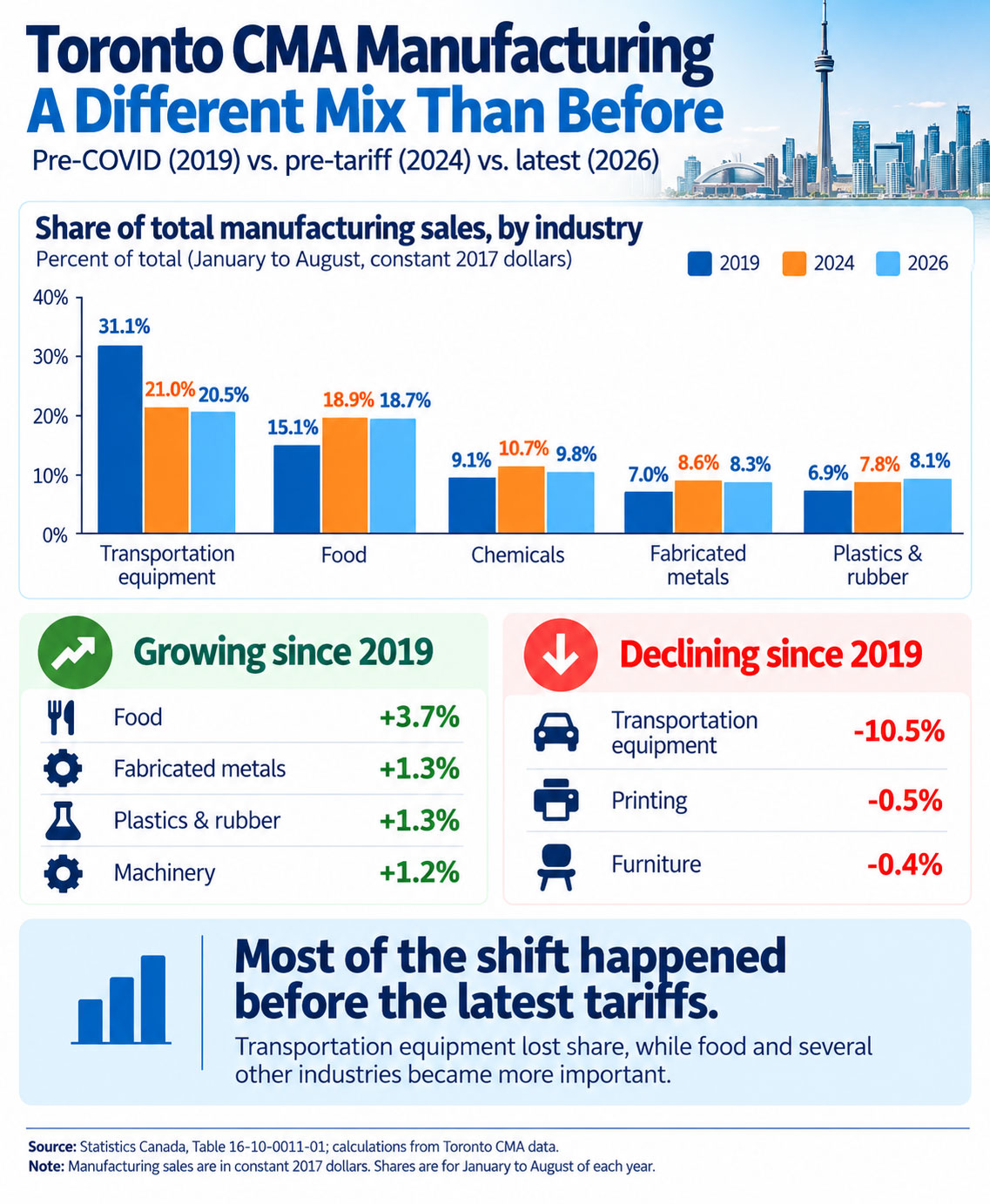
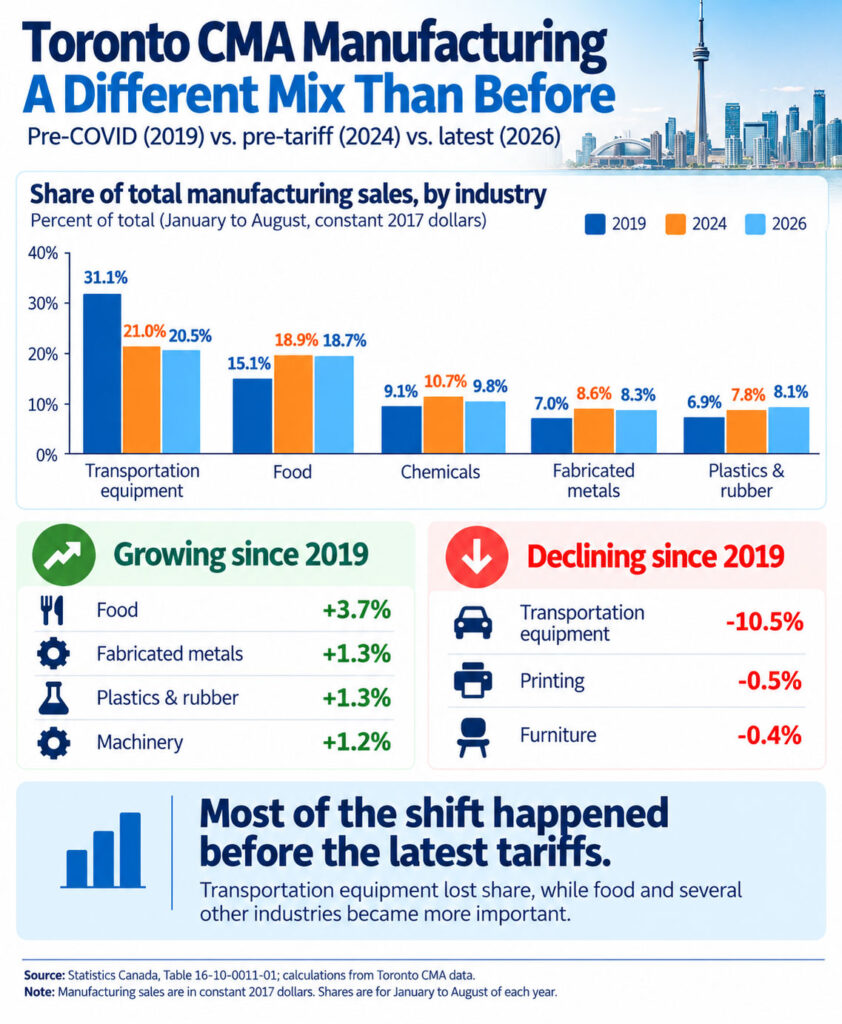
Toronto's manufacturing economy has undergone a significant transformation since COVID-19, but much of that change occurred before the latest U.S. tariffs. In 2019, transportation equipment manufacturing (automotive) accounted for approximately 31% of all manufacturing sales in the Toronto CMA. By 2024, its share had fallen to 21%, and by 2026 it had declined slightly further to 20.5%. Transportation equipment remains the region's largest manufacturing industry, but its relative importance has diminished considerably. This suggests that the restructuring of Toronto's manufacturing economy is a longer-term phenomenon, rather than simply a consequence of recent trade disputes.
Other manufacturing industries have become increasingly important. Food manufacturing's share increased from 15.1% in 2019 to 18.7% in 2026, while fabricated metals, plastics and rubber products, and machinery manufacturing also gained ground. Collectively, these changes suggest a more diversified industrial economy, although not necessarily a stronger one. Manufacturing sales tell us little about productivity, employment or investment, all of which are critical to understanding the region's industrial competitiveness.
The impact of tariffs is more difficult to isolate. Between 2024 and 2026, chemicals, transportation equipment and non-metallic mineral products lost market share, while primary metals, electrical equipment, and plastics and rubber gained ground. These changes are worth watching, particularly given the exposure of many manufacturers to U.S. markets and integrated North American supply chains. However, changes in manufacturing sales cannot establish whether tariffs caused these outcomes. The figures also reflect changes in prices, not simply production volumes. The more important question may be whether tariffs are accelerating structural changes already underway in Toronto's manufacturing economy.