What Truck Driver Job Postings Reveal About Commercial Driver’s Licence Demand in Toronto
TWIG
13 October 2026
What Truck Driver Job Postings Reveal About Commercial Driver’s Licence Demand in Toronto
Online job postings provide more than a measure of how many employers are looking for truck drivers. When advertisements specify a commercial driver’s licence, they can also provide insight into the type of truck-driving demand emerging across different parts of Toronto’s economy.
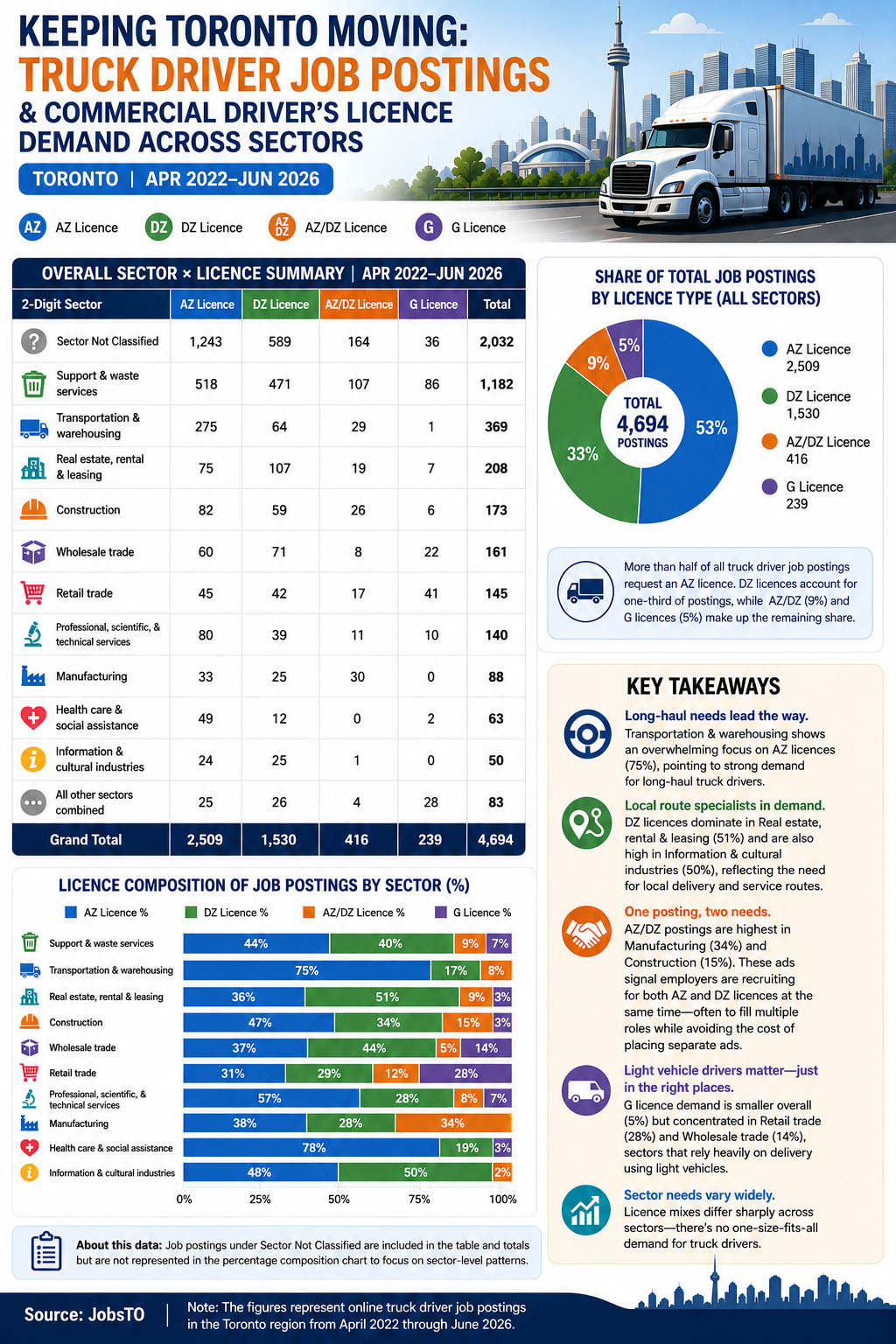
Between April 2022 and June 2026, JobsTO captured 7,417 online truck driver job postings in the Toronto region. Of these, 4,694 postings included licence information that could be classified as AZ, DZ, AZ/DZ or G. The job-posting analysis presented in the infographic focuses specifically on Transport Truck Drivers (NOC 73300), the occupational group that includes commercial truck-driving positions for which AZ and DZ licences are commonly required. It should not be confused with Delivery Service Drivers and Door-to-Door Distributors (NOC 75201), which includes drivers operating automobiles, vans and light trucks for local delivery work. An additional 2,723 postings did not specify a licence type that could be classified under these four categories.
This distinction is important. The infographic does not suggest that the 4,694 postings represent the entire online market for truck drivers captured by JobsTO during this period. Rather, it takes a closer look at the subset of postings where one of the four licence requirements could be identified and asks a more specific question: What does the licence mix tell us about the nature of employer demand for truck drivers?
AZ accounts for more than half of identifiable licence demand
The clearest finding is the prominence of AZ Licence requirements. Of the 4,694 postings included in the licence analysis, 2,509 or 53% requested an AZ Licence. DZ Licence requirements accounted for another 1,530 postings, or 33%. Together, AZ and DZ therefore represent the large majority of identifiable licence demand.
The sector results, however, show why looking only at the overall totals can hide an important part of the story. The balance between AZ, DZ, AZ/DZ and G varies considerably depending on the sector doing the hiring.
For example, Transportation & warehousing is particularly AZ-oriented, with AZ accounting for 75% of its classified licence postings. Health care & social assistance shows an even higher AZ share at 78%. Professional, scientific & technical services also leans toward AZ, at 57%.
Other sectors have a noticeably different licence profile. DZ represents 51% of postings in Real estate, rental & leasing and 44% in Wholesale trade, compared with 17% in Transportation & warehousing. This illustrates that truck driver demand cannot be characterized by a single licence requirement across the economy. Even when employers are recruiting for the same broad occupation, the licence mix can look quite different from one sector to another.
Some sectors have a much more diverse licence mix
Another interesting pattern is the degree to which licence demand is concentrated or spread across several licence types.
Retail trade has one of the most varied licence profiles among the leading sectors: 31% AZ, 29% DZ, 12% AZ/DZ and 28% G. No single licence type dominates to the same extent.
Support & waste services, the largest classified sector by number of postings in the infographic, also shows a relatively broad mix. AZ represents 44% of its postings and DZ another 40%, with AZ/DZ and G accounting for the remainder. The result is a substantially more balanced licence profile than is seen in some of the more AZ-dominated sectors.
These differences matter because they demonstrate that the overall licence shares are only part of the picture.
G Licence demand is small overall but highly concentrated in particular sectors
At 5% of the 4,694 classified postings, G Licence demand appears relatively small when viewed across the entire dataset. Looking sector by sector, however, reveals a pattern that the overall percentage alone would miss.
G Licence requirements account for 28% of Retail trade postings and 14% in Wholesale trade. By comparison, G is virtually absent from Transportation & warehousing and Manufacturing.
This is a useful example of why a relatively small category should not automatically be interpreted as unimportant. A licence type can represent a small share of the overall market while still being a significant component of hiring within particular sectors.
The AZ/DZ analysis answers a narrower question: within the commercial truck-driving labour market, what licences are employers seeking. It should not be interpreted as suggesting that AZ or DZ licences are the most commonly requested driving credentials across the entire labour market.
AZ/DZ postings capture employers recruiting for two licence needs at once
The AZ/DZ category represents 416 postings, or 9% of the classified total. It requires particularly careful interpretation.
An AZ/DZ posting means that, at that point in time, the employer was recruiting for both AZ and DZ licence requirements through a single job advertisement. It should not be read as meaning that AZ and DZ licences are interchangeable or that an employer was simply looking for someone with “either” licence.
One practical reason for advertising the two requirements together may be that an employer can recruit for both needs through one advertisement rather than paying to place separate postings.
The sector distribution makes this category particularly interesting. AZ/DZ represents 34% of Manufacturing postings, considerably higher than its 9% share overall. It also accounts for 15% of Construction postings and 12% of Retail Trade postings. This pattern would be easy to overlook by looking only at the overall number of AZ/DZ advertisements.
The largest hiring sectors do not necessarily have the same licence profile
The infographic also highlights an important distinction between the volume of truck driver job postings and the composition of licence demand.
Support & waste services has the largest number of postings among the classified sectors shown, but its licence mix is relatively balanced between AZ and DZ. Transportation & Warehousing which is at the second spot in terms of job postings is much more heavily concentrated in AZ. Retail trade has fewer postings again yet displays one of the most diverse licence profiles.
In other words, a sector's contribution to truck driver hiring tells us how much demand is being advertised, while its licence distribution provides another layer of information about what that demand looks like.
That distinction can be useful when thinking about workforce development and training. Aggregate demand for “truck drivers” alone does not capture the differences visible in the job advertisements. Looking at licence requirements alongside sector provides a more detailed view of the qualifications employers are requesting.
Finally, the 2,723 additional truck driver postings that did not specify a licence type classifiable as AZ, DZ, AZ/DZ or G should not be overlooked.
Their exclusion from the licence-distribution calculations is analytical rather than an indication that these postings are unimportant. Without a licence requirement that can be classified into one of the four categories, they cannot reliably be assigned to AZ, DZ, AZ/DZ or G without making assumptions that are not supported by the postings.
This also places the infographic in the appropriate context: the licence analysis describes the 4,694 postings for which these requirements could be identified, rather than all 7,417 truck driver postings captured by JobsTO.

The bigger picture
Taken together, the data suggest that Toronto’s online demand for truck drivers is not a single, uniform market. AZ dominates the overall identifiable licence demand, but that headline finding changes considerably when the data are viewed by sector. DZ plays a much larger role in some sectors; G demand, although comparatively small overall, is concentrated in particular parts of the economy; and AZ/DZ postings reveal instances where employers were recruiting for both licence requirements through the same advertisement.
The broader message is therefore not simply that one licence is more frequently requested than another. It is that commercial driver’s licence demand has a distinct sector dimension.
Looking at job postings through this lens provides a more nuanced picture of employer demand, one that goes beyond counting truck driver vacancies and begins to show what kinds of licensing requirements sit behind that demand and how those requirements differ across Toronto’s economy.
Author
-
View all postsToronto Workforce Innovation Group is a non-profit and independent research organization devoted to finding and promoting solutions to employment-related problems in the Toronto Region.