Every product on a store shelf, every shipment arriving at a construction site, and every online order delivered to a customer’s doorstep has one thing in common: someone drove it there. Transport truck drivers are the backbone of Ontario’s supply chain, connecting manufacturers, warehouses, retailers and communities across the province and beyond. Yet, before anyone can get behind the wheel of a commercial truck, they must navigate a licensing system that is more nuanced than many people realize.

For anyone considering a career as a transport truck driver or for employment service providers helping clients explore career options, understanding Ontario’s commercial licensing system is one of the first and most important steps. The licensing process isn’t simply about obtaining permission to drive. Each licence class determines the types of vehicles a driver can legally operate, the kind of work they are eligible for and, ultimately, the employment opportunities available to them.

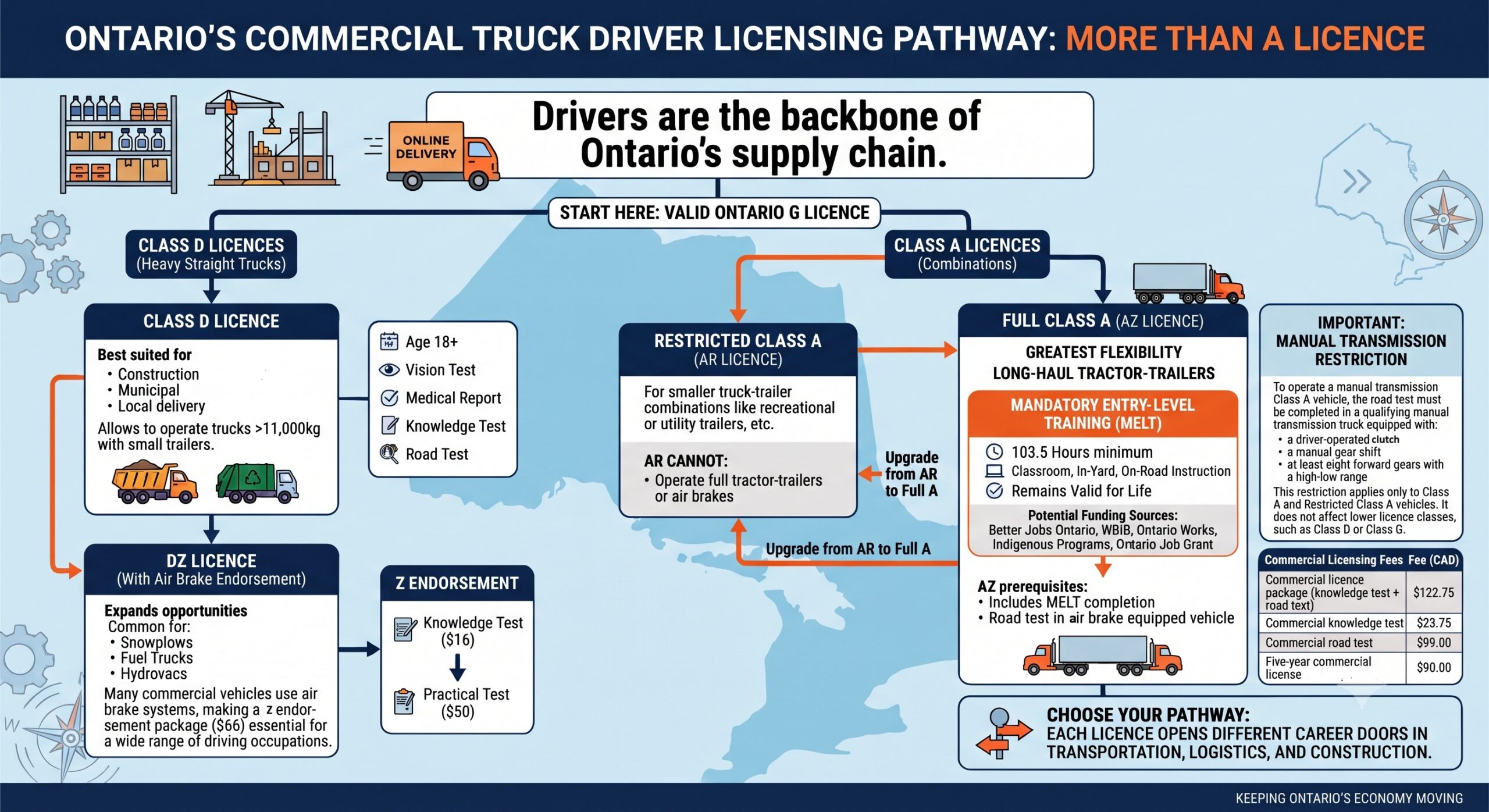
🔍 Click on image for larger view.

What do transport truck drivers actually do?

The occupation includes both long-haul and short-haul/local drivers, and while both move freight, their day-to-day responsibilities can look quite different.

Long-haul transport truck drivers typically:

  • Transport goods across cities, provinces and international borders using tractor-trailers, long-combination vehicles or straight trucks.
  • Plan delivery routes and trip logistics, maintain electronic logbooks and shipping records, communicate with dispatchers, customers and other drivers.
  • Conduct pre-trip, en route and post-trip inspections of vehicle systems.
  • Secure cargo in accordance with safety regulations.
  • Obtain permits and documentation required for cross-border shipments.
  • Transport hazardous materials when properly certified.

Short-haul and local transport truck drivers typically:

  • Deliver goods within cities and neighbouring communities.
  • Operate primarily straight trucks.
  • Load and unload cargo.
  • Inspect vehicles before, during and after trips.
  • Operate specialized equipment such as: dump trucks, tow trucks, hydrovac trucks, cement mixers.

Although the routes differ, both roles demand strong safety awareness, attention to detail, good judgement and compliance with provincial transportation regulations.

Choosing the right licence matters

One of the biggest misconceptions about becoming a truck driver is that there is only one commercial licence. In reality, Ontario offers several licence classes depending on:

  • the weight of the truck
  • the combined weight of the truck and trailer
  • whether the vehicle is a tractor-trailer
  • whether the vehicle uses air brakes

Every commercial licence requires a knowledge test and a road test. Depending on the licence class, applicants may also need to complete government-approved training before booking a road test. If you already hold a commercial truck licence from another Canadian province, your Ontario licence will generally be issued as the equivalent class.

Ontario’s primary truck licence options

Licence Best suited for What it allows
Full Class A (AZ) Long-haul tractor-trailer drivers Operate all tractor-trailer combinations, including vehicles equipped with full air brake systems and double trailers.
Restricted Class A (AR) Drivers operating smaller truck-trailer combinations Operate recreational, horse and utility trailer combinations but not full tractor-trailers or trailers equipped with air brakes.
Class D Heavy straight truck drivers Operate heavy straight trucks exceeding 11,000 kg with smaller trailers. Common for municipal, construction and local delivery work.
DZ Heavy straight trucks equipped with air brakes Operate Class D vehicles fitted with air brakes, expanding opportunities across several industries.


Full Class A (AZ): The licence with the greatest flexibility

A Full Class A licence commonly known as an AZ licence when paired with the Z air brake endorsement provides the broadest driving privileges available in Ontario and is typically required for long-haul tractor-trailer positions.

Drivers holding an AZ licence can operate nearly every type of commercial tractor-trailer combination, making it one of the most versatile licences in the trucking industry.

To obtain a Full Class A licence, applicants must:

  • Be at least 18 years old and hold a valid Ontario driver’s licence.
  • Pass a vision test along with a
  • satisfactory medical report.
  • Pass the commercial knowledge test.
  • Successfully complete Ontario’s Mandatory Entry-Level Training (MELT).
  • Pass the road test in a qualifying tractor-trailer equipped with a full air brake system.

For many employers, an AZ licence represents the greatest employment flexibility because it qualifies drivers for the widest range of commercial driving positions.

Effective January 1, 2027, Ontario will require Class A licence applicants to hold a full Ontario Class G licence (or equivalent) for at least six months before taking the Class A road test. Equivalent driving experience from other Canadian jurisdictions may count toward this requirement under existing licence exchange policies.

Mandatory Entry-Level Training (MELT): An important licensing requirement

Applicants seeking a Full Class A licence must complete Ontario's Mandatory Entry-Level Training (MELT) before they can take the road test. The program establishes a provincial minimum training requirement of at least 103.5 hours covering classroom, in-yard and on-road instruction intended to prepare new drivers to safely operate commercial vehicles. Once completed, the training remains valid and is automatically recorded on the driver's record.

MELT is also required for individuals who:

  • want to upgrade from a Restricted Class A (AR) licence to a Full Class A licence
  • are returning to a Full Class A licence that has been invalid for three years or more
  • hold a commercial truck licence from another country
  • have held an equivalent Class 1 licence from another Canadian province for less than 12 months

Applicants who have held an equivalent Class 1 licence from another province for 12 to 24 months may choose either to complete MELT or to successfully complete the Class A knowledge and road tests. Training must be completed through a provincially approved provider, including registered career colleges and organizations approved under Ontario’s Driver Certification Program.

What does MELT cost?

Unlike licensing fees, there is no fixed provincial fee for MELT. Training providers establish their own tuition rates, which means costs can vary considerably.

However, several funding programs may help eligible individuals offset training costs, including:

  • Better Jobs Ontario
  • Workplace Safety and Insurance Board (WSIB)
  • Ontario Works
  • Indigenous Band funding programs
  • Ontario Job Grant (for employers investing in employee training)

For many prospective drivers, these funding opportunities can make entering the trucking industry much more affordable.

Choosing a training provider: Completing the hours is only part of the picture

Completing MELT is an important step toward obtaining a Class A licence. However, prospective drivers should recognize that not all training experiences are necessarily the same.

Recent findings by the Ontario Auditor General highlighted concerns about whether some approved training providers were delivering the full instruction required under provincial standards. In its review of six providers, the Auditor found that some students received Class A Entry-Level Training certificates despite not completing the required 103.5 hours of instruction. Two providers delivered only 59.5 hours and 81 hours of the required minimum of 103.5 training hours. The review also found that some students were not taught important driving skills such as left turns at major intersections, reverse parking and emergency stopping.

These findings show the importance of selecting a reputable training provider. Prospective students should ask questions about instructor qualifications, actual behind-the-wheel training hours, opportunities to practice key manoeuvres and how the school ensures students develop practical driving skills rather than simply preparing to pass the road test. For employment service providers assisting clients, discussing training quality not just licensing requirements can help individuals make more informed career decisions.

 

Restricted Class A (AR): A practical option for smaller combinations

A Restricted Class A licence allows drivers to operate smaller truck-trailer combinations, making it suitable for hauling recreational, horse or utility trailers. Unlike the Full Class A licence, Mandatory Entry-Level Training is not required to obtain a Restricted Class A licence.

However, drivers wishing to upgrade from an AR licence to a Full Class A licence must complete MELT before taking the Full Class A road test.

Restricted Class A drivers cannot:

  • Operate full-size tractor-trailers.
  • Pull trailers equipped with air brakes.
  • Pull double trailers.
  • Train drivers seeking a Full Class A licence.

While an AR licence may be appropriate for certain occupations, these restrictions can significantly limit employment opportunities compared with a Full Class A licence.

The manual transmission restriction is easy to overlook but important

Since July 1, 2022, Ontario has introduced a manual transmission restriction for both Class A and Restricted Class A road tests.

Drivers who complete their road test using an automatic, semi-automatic or automated-manual vehicle receive a restriction on their licence that limits them to operating only those transmission types in Class A or AR vehicles.

To operate a manual transmission Class A vehicle, the road test must be completed in a qualifying manual transmission truck equipped with:

  • a driver-operated clutch
  • a manual gear shift
  • at least eight forward gears with a high-low range

This restriction applies only to Class A and Restricted Class A vehicles. It does not affect lower licence classes, such as Class D or Class G.

Many modern trucking fleets now operate automatic transmissions. However, employers in some sectors still rely on manual trucks. For prospective drivers, choosing which vehicle to use for the road test may influence future employment opportunities.

Class D: An important pathway into commercial driving

While long-haul trucking often receives the most attention, many commercial driving careers begin with a Class D licence.

A Class D licence allows drivers to operate heavy straight trucks exceeding 11,000 kilograms, provided any trailer being towed remains within the allowable weight limits.

Many employers across Ontario rely on Class D drivers, particularly in sectors such as:

  • Construction
  • Municipal services
  • Utilities
  • Waste management
  • Building materials
  • Food and beverage distribution
  • Local freight delivery

For individuals who prefer to work closer to home rather than travel across provinces, Class D careers can provide an attractive alternative while still offering rewarding employment opportunities.


DZ: Expanding career opportunities with air brakes

Many employers require more than a standard Class D licence. Vehicles such as dump trucks, garbage trucks, cement mixers, fuel trucks, hydrovac trucks and snowplows are commonly equipped with air brake systems, meaning drivers must also obtain a Z endorsement.

Together, the Class D licence and Z endorsement are commonly referred to as a DZ licence.

A DZ licence can open doors to careers in:

  • Construction
  • Municipal public works
  • Waste collection
  • Utility services
  • Emergency services
  • Road maintenance
  • Aggregate and concrete transportation

Many of these positions operate on local or regional routes, allowing drivers to return home at the end of the workday- a feature that appeals to individuals seeking greater work-life balance than traditional long-haul trucking.

Although Ontario does not require Mandatory Entry-Level Training for a DZ licence, many prospective drivers choose to attend professional truck driving schools to gain practical experience operating heavy vehicles equipped with air brakes before attempting the knowledge and road tests.

What does it cost to obtain a commercial licence?

The cost of obtaining a commercial driver’s licence can be a significant barrier for job seekers considering a career in trucking. For an AZ licence, training in Ontario generally costs between $6,000 and $10,000, although some more comprehensive programs can cost $12,000 or more. Most of the cost is associated with the required training program, including classroom instruction, practical driving experience and use of commercial equipment. For a DZ licence, costs are generally much lower. Basic licensing programs may cost around $1,000 to $2,000, while more comprehensive vocational programs typically range from approximately $2,500 to $4,000.

Actual costs vary depending on the training provider, number of practical driving hours, type of equipment used and whether additional training is required. Other expenses may include medical examinations, air brake training, testing, use of a vehicle for the road test and additional training or retesting.

For job seekers, particularly those transitioning from another occupation, these costs can make financial support for commercial driver training an important factor in accessing employment opportunities. And the quality of training can play a big factor in getting a good job in commercial trucking and being a safe driver. In an upcoming post, we will highlight some key questions to ask when evaluating a truck driving school to help you determine whether it is the right fit for you.


Why these requirements matter for the labour market

Commercial driver shortages continue to be discussed across transportation, logistics, manufacturing, construction and distribution industries. However, filling vacancies isn’t simply about attracting more workers. It also requires ensuring prospective drivers understand the licensing pathway, training requirements and qualifications needed for different roles.

Each licence class represents a different level of responsibility, training and job eligibility.

For:

  • Job seekers, understanding licence requirements helps them choose the pathway that best aligns with their career goals.
  • Employment service providers, knowing the licensing process makes it easier to guide clients toward realistic employment opportunities.
  • Employers, licence classifications help determine whether candidates meet operational and safety requirements.
  • Training organizations, understanding demand across licence classes can help shape programs that respond to labour market needs.
  • Policy makers, awareness of licensing barriers and training pathways can support workforce development initiatives aimed at addressing commercial driver shortages.

Understanding the licensing pathway early can save time, reduce unexpected costs and help individuals make informed career decisions while giving employers access to a better-prepared workforce.

Ontario’s commercial licensing system may seem complex at first, but each licence serves a distinct purpose. Whether someone is pursuing an AZ licence to drive tractor-trailers across the country, obtaining a DZ licence to operate heavy municipal or construction vehicles, or starting with a Class D licence for local delivery work, choosing the appropriate licence is one of the most important decisions at the beginning of a commercial driving career.

However, licensing is only the first step. Safe commercial driving also depends on the quality of training, ongoing professional development and consistent regulatory oversight. Recent audit findings demonstrate that meeting regulatory requirements on paper does not always guarantee that every student receives the practical instruction intended by the system.

Ontario's commercial licensing framework is intended to establish minimum standards for operating commercial vehicles safely. However, licensing alone does not determine workforce readiness. The quality of training, practical driving experience and ongoing compliance with safety standards all contribute to preparing drivers for careers in the trucking industry.

Share this post:

Author

  • Toronto Workforce Innovation Group is a non-profit and independent research organization devoted to finding and promoting solutions to employment-related problems in the Toronto Region.

    View all posts
More Than a Licence: Understanding Ontario’s Commercial Truck Driver Licensing Pathway

Understanding Ontario’s Commercial Truck Driver Licensing Pathway

More Than a Licence: Understanding Ontario’s Commercial Truck Driver Licensing Pathway

Help Us Serve You Better

We are collecting data to better understand who is looking for work and what kind of opportunities jobseekers are searching for. This data is completely anonymous and non-personally identifiable.

Your Age:

Skip to content