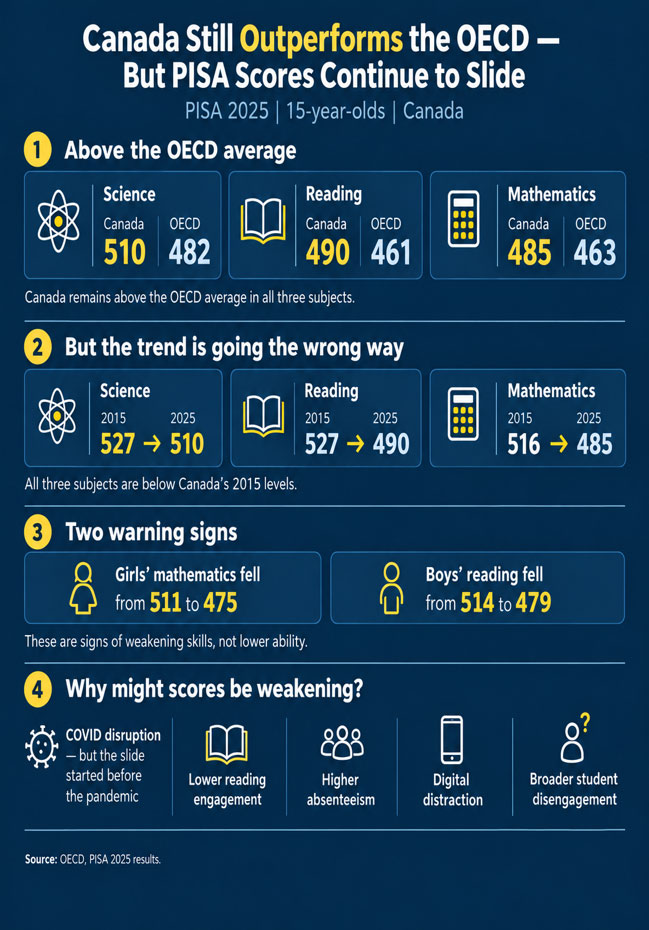
Girls’ mathematics and boys’ reading
Two patterns deserve particular attention. Between 2015 and 2025, Canadian girls’ mathematics scores fell from 511.1 to 475.0, compared with 520.2 to 495.2 for boys. The boys’ advantage widened from roughly nine points to 20.
In reading, boys’ scores fell from 513.5 to 479.0. Girls remained about 22 points ahead in 2025, but their reading scores also declined substantially, more than boys’ over the decade. These are not problems confined to one gender.
These comparisons involve successive groups of 15-year-olds, not the same students followed over time. The implications extend beyond school. We should be concerned about barriers to girls entering technical careers and about boys struggling with the reading required for further training and employment. The response should be targeted support, not assumptions about what either group can achieve.
Why might scores be weakening?
COVID but not just COVID
Pandemic disruption mattered. A 2023 review of 42 studies across 15 countries found substantial learning losses during COVID, with larger deficits in mathematics and among disadvantaged students. But Canada’s mathematics scores were already declining before 2020, and reading and mathematics weakened again between 2022 and 2025. Pandemic effects may persist, but they cannot explain a decline that began before the pandemic.
Less reading and less careful reading
The OECD identifies reduced reading for pleasure alongside increased screen time as possible contributors to weaker results. Reading is not simply another school subject: understanding written information supports learning across subjects.
Its 2025 analysis also found that the share of “hasty” readers—students answering rapidly but inaccurately almost doubled from 2018 across OECD countries. This suggests attention and engagement deserve scrutiny alongside basic reading skills. It does not establish that screens caused the decline.
Attendance: students need to be there
In Canada, 32% of students reported skipping at least one full school day during the two weeks before the 2025 assessment, compared with 23% in 2018 and 29% in 2022. The 2025 OECD average was 22%.
The practical point is straightforward: students who are not in class miss instruction, practice and feedback. Learning can happen elsewhere, but regularly missing lessons makes benefiting from school harder. Understanding why students disengage matters as much as recording that they are absent.
Digital distraction
Across OECD countries, 28% of students reported classmates being distracted by digital devices during most or all science lessons. Distraction was associated with lower science performance, even after accounting for socioeconomic background.
However, that adjusted relationship was not statistically significant in Canada. Phones cannot simply be declared the cause of Canada’s decline. The useful distinction is between technology that supports learning and technology that interrupts it.
Student and Family Engagement
The share of Canadian students reporting that parents asked about their school day at least weekly fell from 78% in 2022 to 69% in 2025. Weekly discussions about problems at school fell from 55% to 40%.
These figures do not prove that parents care less. They suggest changes in the routines connecting home and school. Internationally, the OECD also found declining interest in learning new things across many systems. Attendance, motivation and family support may reinforce one another.
Something more structural?
A sustained decline warrants questions beyond pandemic recovery. Are students getting enough practice with demanding texts and mathematical reasoning? Are learning gaps identified early? Do teachers have the support and time to address them? Are expectations clear?
PISA cannot establish which teaching approach, curriculum or social change caused the results. Nevertheless, the persistence of weaker performance makes it difficult to treat the problem as a temporary interruption.
For employers and post secondary institutions, the risk is practical: new entrants may need more support to understand technical instructions, interpret charts or complete occupational training. Repairing foundational gaps could take time away from developing the advanced skills that changing workplaces require.
AI makes the Foundations More Important
AI does not make these results obsolete. It changes what we need to do with knowledge.
Consider an AI-generated explanation of a machine fault. A worker still needs to understand the explanation, check whether the measurements make sense and judge whether the evidence supports the recommendation. Producing an answer and evaluating an answer are different tasks. The OECD argues that AI should support students’ thinking rather than substitute for it. Used purposefully, it can provide feedback and practice; used as a shortcut, it can remove opportunities to develop understanding.
PISA is not a complete test of AI readiness, and lower scores do not demonstrate declining innate intelligence. The concern is weaker demonstrated skills and whether those weaknesses make further learning harder.
There is encouraging evidence, too: Canada scored 525 in PISA’s new computational problem-solving assessment, above the OECD average of 500. That is a strength to build on, not a reason to overlook weakening literacy and numeracy.
Human Capital Deserves the Headlines
Tariffs between Canada and the US are grabbling all the oxygen in terms public policy. For years, Canada’s stronger PISA results than those of the United States pointed to an important potential economic advantage: a stronger foundation in literacy, numeracy and scientific understanding. But that record is no longer grounds for complacency. In 2025, Canada’s science score was not statistically distinguishable from the American result, while Canadian scores in all three subjects were significantly below their 2015 levels. The concern is not simply whether we remain ahead of our neighbour, but whether we are maintaining the skills on which future prosperity depends. A trade war puts immediate attention on tariffs and market access, but it also raises a longer-term question: how well are we developing our own human capital?